

Stockpiling Presence
why abundance isn't about having more

I planned a two-night backpacking trip this weekend. I miss sleeping on dirt, and the intense reflection I get from walking by myself in the woods all day. I arranged a drop off that would let me link multiple trails over about 28 miles. I checked trip reports and weather, and I started walking late Friday morning. The weather report showed that there would be some showers in the afternoon, but not much total rain. I was planning on being a little wet, but that’s typical for mid-May in the lower Cascades.
Reality
By the time I stopped for a late lunch, the snow was falling. I knew I had a climb in the afternoon on a trail that wasn’t used often (this is what happens when you link trails sometimes). I didn’t expect it, but I spent the next three hours kicking steps into a massive snowfield. In hindsight, I probably should have turned back, but I was confident enough in my abilities and the route to push on, and I did.
I finally made it to a campsite around 7:00pm. By this time, the snow was falling hard, and instead of camping on dirt, I camped on snow. My tent buckled twice during the night under the weight of the snow. I sat up, gave my tent a few slaps with the back of my hand to knock the snow and ice off, and it was as good as new.
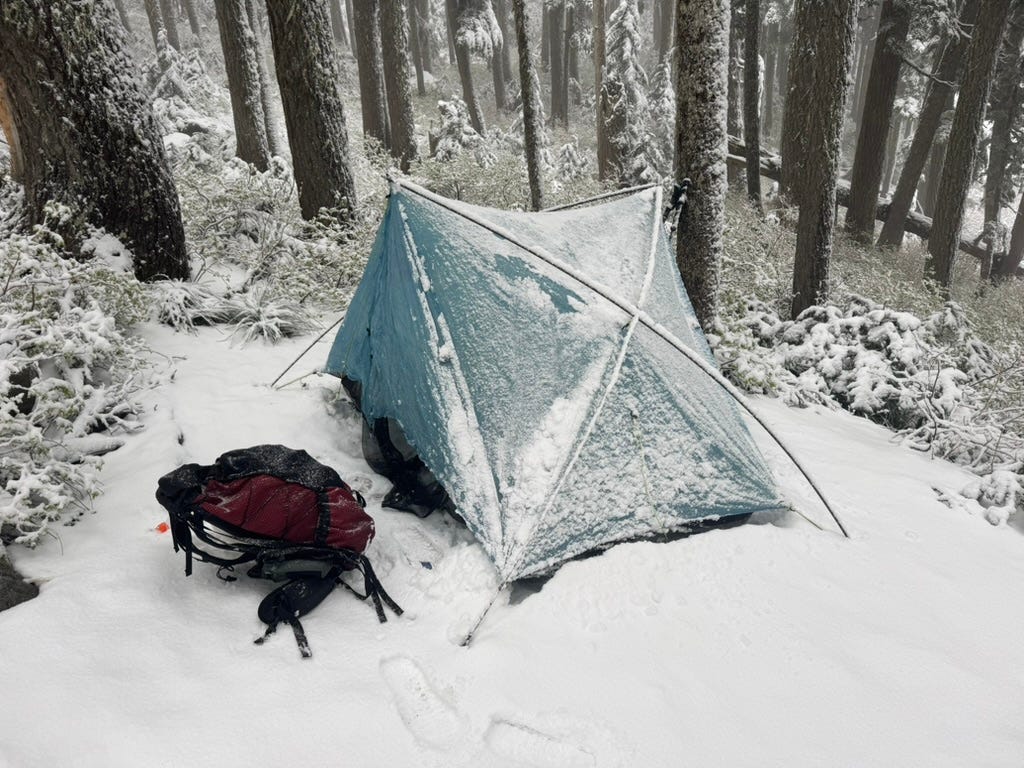
I crawled out of my tent around 7:30am, packed, and continued my hike. By mid-morning, I was wading through knee deep powder, and my intended route had a big climb to even higher elevation. As much as I really wanted another full day of hiking, I knew it wouldn’t be safe (or pleasant) to push through. I found an alternate path back to a trailhead and headed home a day early (where I luckily picked up a ride from Rayla (dog), and her owner, Kevin).
Abundance and Scarcity
On my ride home (and during a long hot shower) I found myself thinking more about abundance. Specifically, about how badly I had wanted those two days, and how the wanting had almost become the point of the hike.
There’s a version of abundance that’s actually just accumulated scarcity. You go without something long enough that when you finally have it, you can’t settle into it. You’re too aware of how temporary it is, too busy trying to extract maximum value from every moment to actually be fully yourself in them.
I recognize this pattern in my own life. And I recognize it in engineering organizations.
Teams that operate in information scarcity, where nobody really knows what’s happening, where priorities shift without explanation, where feedback only comes at annual review time don’t suddenly become healthy when you throw a company offsite at them. They binge. They try to resolve months of uncertainty in two days, and then they go back to the drought. The offsite doesn’t fix anything. It just makes the return to normal feel worse.
More Isn’t Always the Answer
We tend to imagine abundance as volume. More time, more resources, more access, more of the thing we’ve been missing. If I could just have a week instead of a weekend. If the team could just have two more engineers. If we could just have more runway.
But volume without presence isn’t abundance. It’s just a longer version of the same scarcity mindset, stretched out over more time.
I’ve watched leaders try to solve chronic feedback deficits with quarterly all-hands events. I’ve watched teams try to solve chronic alignment problems with week-long off-sites. I’ve watched relationships of all kinds try to compensate for long absences with intense bursts of togetherness that feel great in the moment, but leave too much on the table.
It doesn’t work because abundance isn’t actually about quantity.
Getting it Right
The organizations I’ve seen get this right don’t stockpile trust and deploy it in bursts. They distribute it consistently, in small amounts, over time. A leader who gives their team honest information every week, even when the information is uncomfortable, builds something that a quarterly state-of-the-company address never can.
Abundance in a team looks like psychological safety that’s reliable and predictable rather than occasional. It looks like feedback that’s frequent enough to be normal rather than rare enough to be alarming. It looks like people who don’t hoard information because they’ve learned that more is always coming.
The hike taught me something I probably already knew but needed to feel again. Two days in the mountains sounds like abundance. But what I actually wanted and what I was actually missing was the particular kind of attention that comes from being somewhere without an agenda or distractions. The snow took some of that away from me.
And in my walking, my brain brained something interesting that I’ve been thinking about.
You can have more of something than you need and still feel the scarcity. You can have less than you planned and still find what you came for.
The question worth asking for leaders, for teams, and for anyone navigating the gap between what they planned and what they got is whether you’re measuring abundance by volume or by quality of presence.
One of those is always in shorter supply than you think. The other is more available than you realize.
If any of this resonates and you’d like to talk more about it - or how I can help you. Set up some time to chat.