

The Quiet Power of Caring
We talk a lot about engagement, feedback, and performance. But underneath it all, there’s something much simpler - and much harder - that makes people thrive: feeling cared for.

The Leadership Power of Feeling Seen
Sometimes leadership lessons don’t show up in a conference room, or a Zoom meeting. They sneak in through small moments - a late-night message, a quiet “how are you, really,” a simple act of care that just makes someone feel a little more human, and less like a cog in a machine.
Patrick Lencioni once wrote that the three signs of a miserable job are anonymity, irrelevance, and immeasurability.
Anonymity is when no one seems to know or care who you are.
Irrelevance is the sense that your work doesn’t really matter to anyone.
And immeasurability is not knowing whether you’re succeeding or falling short.
Together, they create the quiet despair of work that feels invisible - when effort goes unnoticed, purpose feels distant, and progress is impossible to see.
When no one really knows you, when you can’t see how your work matters, and when you have no way to tell if you’re doing well - work begins to shrink you.
The job might be fine.
The pay might be fine.
But something’s missing.
Those three signs don’t just describe miserable jobs; they describe miserable relationships and teams, too.
‘They all share the same quiet ache: I don’t feel seen. I don’t know if I matter. I’m not sure how I’m doing.
From Disconnection to Meaning to Action
Dan Pink later framed this same dynamic from the opposite angle.
In Drive, he describes three ingredients of intrinsic motivation: autonomy, mastery, and purpose. When people have freedom to shape their work (autonomy), the chance to get better at it (mastery), and a reason that matters (purpose), they come alive.
It’s the same human truth seen from a different direction - people need to feel known, capable, and connected to something that matters.
Russ Laraway then took that insight and asked the practical question every manager faces: how do we create that kind of environment every day? In They Win, You Win, he identifies three behaviors that drive engagement: direction, coaching, and career.
Direction gives people clarity - what’s expected, why it matters, and how it fits.
Coaching gives them feedback and encouragement - a way to see their own progress.
Career creates connection - managers take genuine interest in the person, not just the role.
It forms a clear arc:
Lencioni → what makes work miserable (disconnection).
Pink → what makes work meaningful (intrinsic drive).
Laraway → what managers can do to make that meaning real (direction, coaching, career).
Line them up and it’s almost poetic:
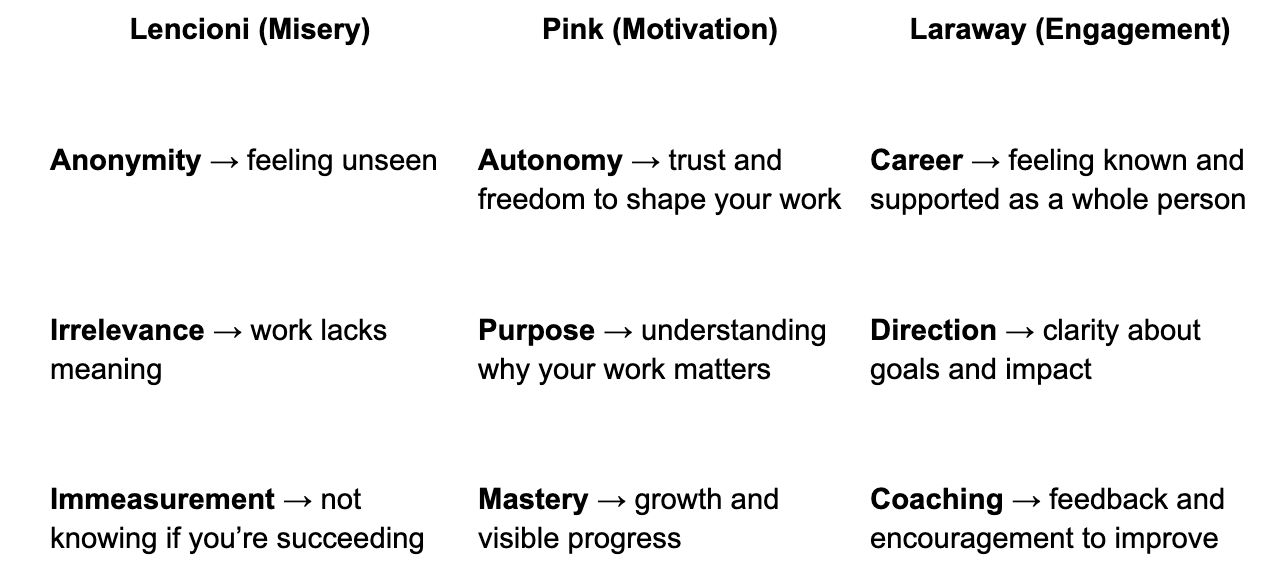
What Lencioni diagnosed as the causes of misery, Pink reframed as the elements of motivation, and Laraway turned into the behaviors of engagement.
All three point to the same truth: people thrive when they feel seen, purposeful, and supported.
Care as the Thread Through It All
A few days ago, I had a conversation with a friend that reminded me what care actually feels like. They’d had a hard day and reached out - not to be fixed, just to be seen. I gave support, offered space, and reminded them I was there. What struck me wasn’t what either of us said - it was how mutual the moment felt. They let me in, and I offered care. They met it with gratitude and warmth. We both walked away feeling steadier.
That’s what real care feels like - grounding, not draining.
It’s not grand or dramatic; it’s presence.
It’s people choosing to stay connected even when things are messy.
At work, we often treat care as something leaders give - a one-way act of empathy. But real care, the kind that builds trust and engagement, is mutual. It’s built in the space where everyone involved is allowed to be human.
Several years ago, I was leading a large team spread across at least a dozen countries. I met with the entire 300 person organization regularly (mostly to share business status and answer questions).
At the time, Covid lockdowns were in full swing, wars were starting, and politics were a heavy weight for a lot of my team members.
For a time, we skipped a lot of the business stuff. We spent part - and often all of every bi-monthly meeting talking about how people were doing, offering help, and learning how to be the best humans we could for each other.
They knew I cared - but they knew that we all cared about each other. It was amazing, and necessary. It helped the organization succeed in times where many organizations were falling apart.
Mutual Care Is the Highest Form of Leadership
When leaders genuinely care, they dismantle anonymity.
When they connect people’s work to purpose, they erase irrelevance.
When they coach with honesty and curiosity, they remove immeasurability.
Care is the foundation that makes direction, coaching, and career work. Without it, they’re just process. With it, they become trust.
I’ve led teams where that mutual care was real - where people cared for one another, including me. Feedback flowed more easily. Accountability felt natural. Wins felt shared. The work wasn’t just productive; it was alive.
That’s the heart of engagement. Not a survey score or a program, but the daily, human practice of seeing each other fully.
When people feel seen, they show up differently.
When they show up differently, the work transforms.
And when the work transforms, everyone wins.
This is what leadership really looks like - quiet, mutual, and deeply human.
💯! I just cannot stop twisting my head why so many leadership people do not seem to care, it is an essential for them to have/demonstrate, yet in many organizations I’ve seen there has
been managing up, and leads that are even checked out and detached from the people. What would you do in those organizations?